
Most businesses believe financial reporting exists to explain performance. Family offices believe financial reporting exists to preserve wealth. The distinction may appear subtle, but it fundamentally changes what information is reported, how it is reported and why it matters.
Ask the average business owner what they expect from a monthly report and the answer is often predictable: revenue, profit, expenses, cash balance and perhaps a few operational metrics. For many organisations, that level of reporting is sufficient. For a family office, it is rarely enough.
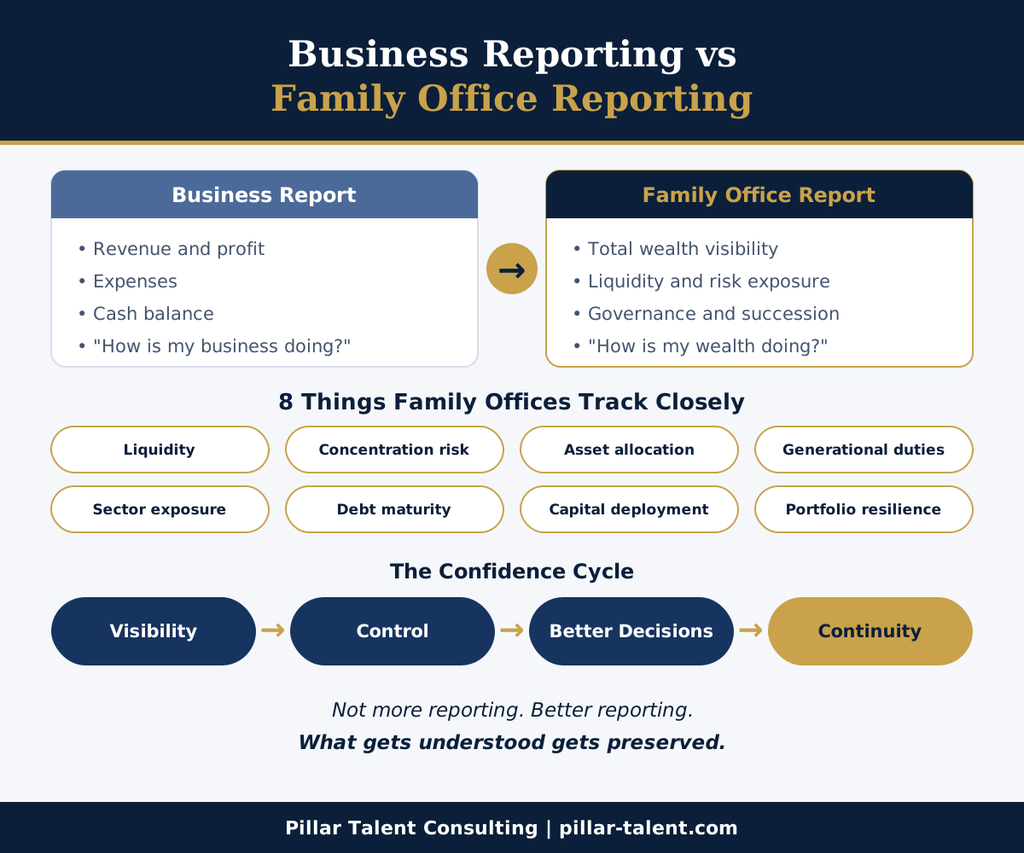
Business Reporting vs Family Office Reporting
The reason is simple. A family office is not managing a business. It is managing a collection of assets, risks, obligations, opportunities and generations. The scope is entirely different.
A founder typically asks, “How is my business performing?” A family office asks, “How is my wealth performing?” The questions sound similar, but they are not. Consider how they can diverge:
- A business can be profitable while family wealth is deteriorating.
- A portfolio can appreciate while liquidity becomes constrained.
- Assets can increase while governance weakens.
- Revenue can grow while concentration risk rises.
Wealth is multidimensional, and measuring it requires a broader perspective. A Fractional CFO can provide that perspective by connecting business performance, investments and family objectives in one clear view.
Why Visibility Drives Control and Continuity
This explains why sophisticated family offices place extraordinary emphasis on reporting. They do not do so because they enjoy reports. They do so because visibility is one of the most important drivers of control, and control is one of the most important drivers of continuity.
Why Intuition Stops Working as Wealth Grows
Many successful entrepreneurs manage their affairs through intuition. They know their businesses, understand their investments and trust their instincts. These capabilities frequently contribute to the creation of wealth.
As wealth grows, however, intuition becomes less reliable. Complexity increases, and the number of assets, stakeholders and decisions multiplies. Visibility begins to decline. At some point, no single individual has complete knowledge. The founder who once understood every aspect of the enterprise now oversees a collection of businesses, properties, investments, partnerships, financing arrangements and family interests.
The challenge is not competence. The challenge is scale. This is the moment when reporting evolves from a financial exercise into a strategic necessity. As we explain in the CFO’s view of family wealth preservation, the transition from creating wealth to preserving it demands stronger systems and governance.
Better Reporting, Not More Reporting
The strongest family offices understand that wealth cannot be managed effectively without visibility, and visibility requires reporting. Not more reporting, but better reporting.
Reporting Volume vs Reporting Quality
Many organisations confuse reporting volume with reporting quality. They produce lengthy reports filled with information nobody uses: dozens of pages, hundreds of data points and thousands of numbers. Despite all this activity, decision-making often remains weak. The problem is not the absence of information. It is the absence of insight.
Family offices understand that the purpose of reporting is not to document history. It is to improve decisions. This principle shapes what gets reported, how frequently, who receives it and what actions follow. The objective is not simply awareness. It is informed action.
Insight starts with reliable numbers. Accurate, timely reporting depends on disciplined finance operations and month-end close, including reconciliations, internal controls and consistent management information across every entity and asset.
What Family Offices Report That Traditional Businesses Overlook
Sophisticated family office reporting often focuses on areas that conventional business reporting overlooks:
- Liquidity
- Concentration risk
- Asset allocation
- Intergenerational obligations
- Exposure to specific sectors
- Debt maturity profiles
- Capital deployment effectiveness
- Portfolio resilience
These considerations rarely dominate conventional management reports, but they frequently dominate family office discussions. Strong cash flow forecasting and board-level reporting help families see liquidity pressures and capital deployment results before they become problems.
Two Different Ways of Looking at Risk
Family offices think differently about risk. The average business evaluates risk through an operational lens: Will sales increase? Will costs rise? Will margins improve?
Family offices evaluate risk through a wealth preservation lens:
- What happens if a major asset underperforms?
- What happens if liquidity is required unexpectedly?
- What happens if future generations become involved?
- What happens if market conditions change dramatically?
- What happens if succession occurs sooner than expected?
These questions require a broader reporting framework, one capable of connecting individual decisions to long-term outcomes. Debt exposure, tax positions and compliance obligations also belong in that framework. Our tax and compliance advisory supports UAE families and businesses with corporate tax and VAT readiness, so hidden liabilities do not erode wealth.
Thinking in Decades, Not Quarters
Long-term thinking is one of the defining characteristics of successful family offices. Many entrepreneurs think in years. Family offices frequently think in decades, and some think in generations.
This changes the nature of reporting. Quarterly fluctuations become less important and structural trends become more important. Temporary volatility becomes less significant and long-term resilience more significant. The objective is no longer merely to understand current performance. It becomes understanding future sustainability.
Governance and Reporting Work Together
This distinction explains why governance and reporting are so closely connected. Governance without visibility becomes ineffective, and visibility without governance goes unused. The two reinforce each other, and together they create confidence.
Confidence allows better decisions, better decisions improve continuity and continuity supports wealth preservation. This cycle sits at the heart of sophisticated family office management. Families that want to build it can use business and finance consulting to design the operating model, control frameworks and financial governance that make reporting effective.
Why Reporting Systems Cannot Be Built Overnight
Unfortunately, many families discover the importance of reporting only after problems emerge. A dispute arises, an investment underperforms, a liquidity challenge appears or a succession event occurs. Suddenly information becomes critically important, and the family begins searching for answers.
The problem is that reporting systems cannot be built overnight. Strong reporting is the result of discipline. It reflects years of consistent measurement, documentation and analysis. This is the same principle investors apply, as we explain in why investors ask for three years of financial statements.
If you are not sure how strong your current reporting is, try the Business Health Analyzer for a quick 60-second scan, or see how our structured process takes businesses from diagnosis to scalable execution.
Why the Best Family Offices Stay Calm
This is one reason the strongest family offices often appear remarkably calm during uncertainty. Their confidence is not based on optimism. It is based on visibility. They know what they own, understand how it is performing and recognise emerging risks. They can make decisions quickly because information is readily available.
This capability becomes more valuable as wealth grows, because wealth itself does not create clarity. In many cases, it creates complexity. The larger the portfolio, the more important visibility becomes. The larger the family, the more important governance becomes. The larger the opportunities, the more important discipline becomes. Reporting sits at the centre of all three.
“What Gets Measured Gets Managed”
Peter Drucker famously observed, “What gets measured gets managed.” Family offices understand a deeper truth: what gets understood gets preserved. The purpose of reporting is not merely measurement. It is understanding, and understanding is one of the most valuable assets any family can possess.
Ultimately, family office reporting is not about producing documents. It is about creating confidence: in decisions, in governance, in continuity and in the wealth created today remaining capable of serving future generations tomorrow.
Frequently Asked Questions
How is family office reporting different from traditional business reporting?
Family office reporting focuses on total wealth visibility, risk management, liquidity, governance, succession considerations and long-term continuity rather than purely operating performance.
Why is liquidity reporting important for family offices?
Significant wealth can exist without sufficient liquidity. Family offices need visibility into both asset value and cash availability. Our finance operations service helps build this reporting discipline.
What role does reporting play in succession planning?
Reporting creates transparency, supports governance and helps future generations understand and manage family wealth responsibly.
Why do family offices emphasise risk visibility?
The primary objective is often preservation rather than maximising short-term returns. Risk visibility supports better long-term decision-making.
What is the biggest reporting mistake wealthy families make?
Many focus on asset values while overlooking governance, concentration risk, liquidity and decision-making visibility. Learn more about Pillar Talent and how we help families and businesses fix this.
Final Thought: Wealth Preservation Begins With Visibility
Wealth preservation begins with visibility. The families that sustain wealth across generations are rarely those with the most information. They are often those with the greatest understanding.
Want clearer reporting for your family business or office in the UAE? Book a consultation or contact our team. We support clients in Dubai, Abu Dhabi and Sharjah.
If this article resonated with you, consider sharing it with a founder, family business leader, investor, family office executive or next-generation wealth steward who may be thinking about governance, continuity and long-term wealth preservation. For more articles like this, visit our Insights page.
At Pillar Talent, we believe that better visibility creates better decisions, and better decisions create stronger legacies.