
There comes a point in the life of every successful family when the conversation changes. For years, the focus is clear: build the business, acquire assets, expand the portfolio, increase revenue and create wealth. Success is measured through growth in turnover, assets, market share and influence..
For many entrepreneurs, these objectives become second nature. They spend decades developing the instincts, discipline and resilience required to create wealth, and their identity becomes closely tied to the pursuit of opportunity.
Then something interesting happens. The business becomes successful, the properties are acquired, the investments begin compounding and the balance sheet strengthens. A new question emerges: how do we ensure this survives us?
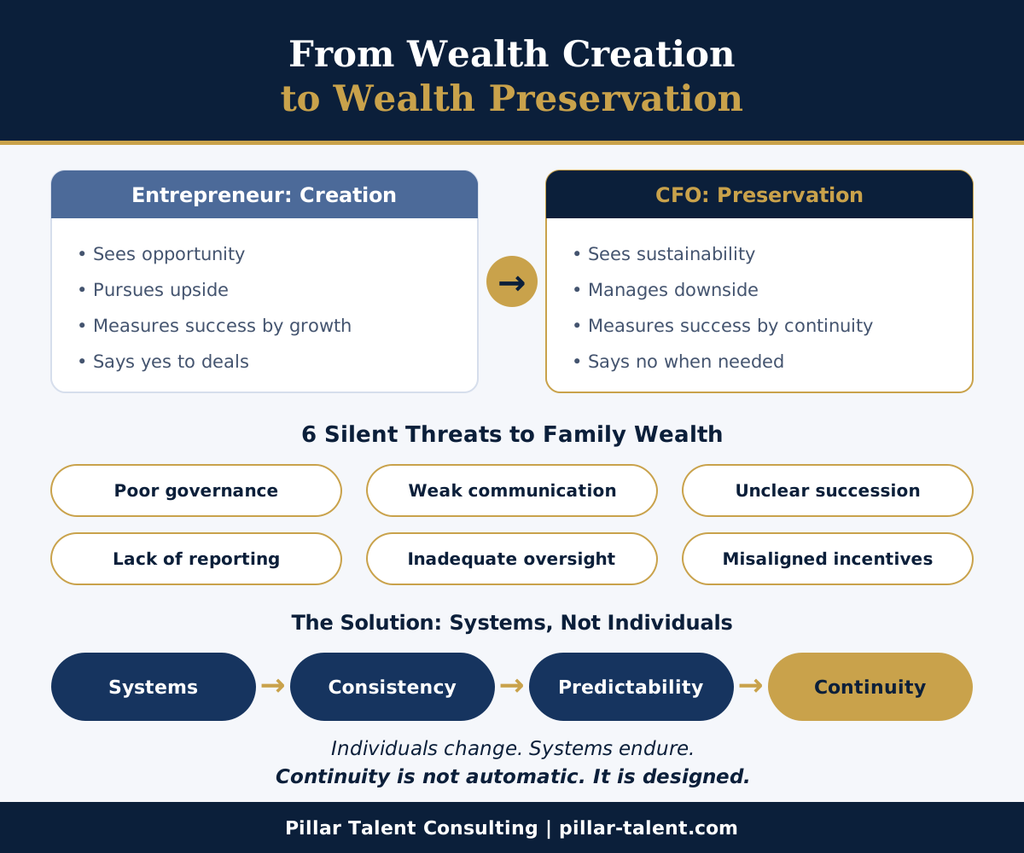
From Wealth Creation to Wealth Preservation
This is the moment when wealth creation gives way to wealth preservation. Most families underestimate how significant this transition is. They assume the skills that created wealth will naturally preserve it, but history suggests otherwise.
Around the world, family wealth has repeatedly shown an extraordinary ability to disappear. This is not because families stop being intelligent, because opportunities vanish or because markets collapse. More often, wealth erodes because preservation requires a different set of disciplines than creation.
Entrepreneurs Pursue Upside, Family Offices Manage Downside
This distinction sits at the heart of how sophisticated family offices think. Entrepreneurs are trained to pursue upside. Family offices are designed to manage downside. One focuses on growth, the other on continuity. Both are essential, and neither is sufficient on its own.
Wealth preservation often feels less exciting than wealth creation. Building a company generates stories, acquiring a major asset creates visibility and closing a deal creates momentum. Governance, reporting, risk management, succession planning and capital allocation rarely generate the same excitement. Yet these disciplines often determine whether wealth survives beyond the first generation.
How a CFO Sees Wealth Differently From an Entrepreneur
Experienced CFOs frequently view wealth differently than entrepreneurs. The entrepreneur sees opportunity, while the CFO sees sustainability. The entrepreneur asks, “How can we create more value?” The CFO asks, “How can we ensure existing value is protected?”
Both perspectives matter, and the strongest families learn to balance them. Unfortunately, many families become weighted toward one side. The founder stays focused on growth long after preservation should have become a priority. The result is predictable: assets increase, complexity increases and risk increases, while governance remains unchanged. Eventually the gap becomes visible.
This is where a Fractional CFO can add real value. A fractional CFO gives families senior financial leadership, board-level reporting and long-term financial planning without the cost of a full-time executive team.
Why Governance Failures Destroy More Wealth Than Market Volatility
Wealth preservation is rarely about investment performance alone. Many people assume it is primarily an investment problem and focus on portfolio returns, asset allocation and market performance. These matter, but some of the greatest threats to family wealth come from elsewhere:
- Poor governance
- Weak communication
- Unclear succession
- Lack of reporting
- Inadequate oversight
- Misaligned incentives
These issues have destroyed more family wealth than market volatility ever will. Investment losses can often be recovered, while governance failures frequently cannot. That is why many sophisticated family offices devote significant resources to governance structures. For families that need to build them, business and finance consulting helps design the operating model, control frameworks and financial governance that protect wealth across generations.
Uncertainty Is an Expensive Liability
The objective of governance is not to control family members. It is to reduce uncertainty, which is one of the most expensive liabilities a wealthy family can carry. Uncertainty creates disputes, disputes create fragmentation and fragmentation destroys continuity.
The process is rarely immediate. It unfolds gradually. A disagreement emerges, a decision is delayed, a family member feels excluded, an investment is poorly understood or an ownership transition is mishandled. Individually, these events appear manageable. Collectively, they become dangerous.
Preservation Is Achieved Through Systems, Not Individual Decisions
The strongest family offices understand that preservation is not achieved through individual decisions. It is achieved through systems. Systems create consistency, consistency creates predictability and predictability supports continuity.
Reporting Is a Governance Function
This is why reporting occupies such a central role in sophisticated wealth management. Many entrepreneurs view reporting as an accounting function, while family offices view it as a governance function. Reporting provides visibility, visibility creates control and control enables informed decision-making. Without visibility, wealth becomes increasingly difficult to manage.
Reliable reporting depends on disciplined finance operations and month-end close, including reconciliations, internal controls and consistent management information across every entity, asset and business the family owns.
Why Visibility Becomes Harder With Each Generation
This challenge grows as families grow. The first generation often understands every asset. The founder knows every investment, business relationship, property and strategic decision. The second generation inherits a more complex environment, and the third inherits something more complicated still. Eventually, no single individual has complete visibility.
At this point, systems become essential. The family can no longer rely on memory and must rely on governance. This transition is one of the defining characteristics of successful family offices. They institutionalise knowledge, document processes, create decision-making frameworks and build reporting systems. Most importantly, they reduce dependence on individuals, because individuals change and systems endure.
If you are unsure where your own gaps are, the Business Health Analyzer offers a quick 60-second scan of your business performance, and our structured process shows how we diagnose, stabilise, systemise, optimise and scale.
Capital Allocation: Learning to Say No
The same principle applies to capital allocation. One of the most overlooked threats to wealth preservation is poor capital allocation. Successful entrepreneurs are used to pursuing opportunities aggressively, and that behaviour is rewarded during the wealth creation phase. Preservation requires a different mindset.
Not every opportunity should be pursued, not every investment should be approved and not every acquisition creates value. The ability to say no becomes increasingly important. Ray Dalio has often observed that successful decision-making depends on understanding risks as deeply as opportunities. The same applies to wealth preservation: protecting wealth requires equal attention to what could go wrong.
This does not imply conservatism. It implies discipline. The objective is not to eliminate risk, but to ensure risks are intentional, understood and aligned with long-term objectives. Good capital allocation also depends on structure. For businesses and holding companies in the UAE, clear tax and compliance advisory supports better decisions on structuring, corporate tax exposure and VAT compliance, and helps avoid penalties that quietly erode wealth.
Where the CFO Perspective Becomes Valuable
The CFO sits at the intersection of growth and preservation. They understand how wealth is created, and they understand how wealth is lost. More importantly, they recognise that wealth erosion rarely begins with dramatic events. It usually begins with small decisions repeated consistently over time:
- Weak reporting
- Poor oversight
- Undisciplined capital allocation
- Unclear accountability
- Governance gaps
These issues rarely attract attention immediately. They become visible years later, and by then the consequences are often difficult to reverse. Family-owned businesses also face people-related obligations that need planning, such as gratuity under the End of Service Calculator and workforce targets under the Emiratisation Calculator. These are often overlooked until they become urgent.
“Wealth Is What You Don’t See”
Morgan Housel famously wrote, “Wealth is what you don’t see.” The observation captures a profound truth. The visible aspects of wealth, such as the properties, businesses, investments and lifestyle, often receive the most attention. The invisible aspects frequently matter more: the governance, the reporting, the decision-making frameworks and the continuity planning.
These are the mechanisms that allow wealth to survive. The families that endure across generations understand this distinction. They realise that creating wealth is an achievement and preserving wealth is a responsibility. The transition from one to the other is one of the most important moments in the life of any successful family.
Wealth Preservation Is About Protecting Optionality
Ultimately, wealth preservation is not about protecting money. It is about protecting optionality:
- The ability to make decisions
- The ability to support future generations
- The ability to pursue opportunities
- The ability to remain independent
The strongest family offices understand that wealth is not merely an asset. It is a platform, and platforms require governance. This long-term view is also what investors look for. As we explain in why investors ask for three years of financial statements, disciplined reporting builds confidence over time.
Frequently Asked Questions
What is the biggest threat to family wealth?
In many cases, governance failures, poor succession planning and weak decision-making frameworks pose greater long-term risks than market volatility.
How do family offices approach wealth preservation differently from entrepreneurs?
Family offices focus heavily on continuity, governance, risk management and long-term stewardship, while entrepreneurs often prioritise growth and opportunity.
Why is reporting important in wealth preservation?
Reporting creates visibility. Visibility supports better decision-making, stronger governance and improved accountability. Our finance operations service helps families build this reporting discipline.
Does wealth preservation mean avoiding risk?
No. Effective wealth preservation involves understanding and managing risk rather than eliminating it entirely.
When should a family begin focusing on wealth preservation?
Ideally long before a succession event occurs. The strongest preservation strategies are implemented while the founder remains actively involved. Learn more about Pillar Talent and how we support founders and families.
Final Thought: Continuity Is Designed
Creating wealth is one of the greatest achievements in business. Preserving it may be one of the greatest responsibilities. The families that endure across generations understand that continuity is not automatic. It is designed.
Planning the future of your family’s wealth in the UAE? Book a consultation or contact our team. We support families and businesses in Dubai, Abu Dhabi and Sharjah.
If you found this article valuable, consider sharing it with a founder, investor, family business owner, family office executive or next-generation leader who is thinking about the future of wealth beyond the current generation. For more articles like this, visit our Insights page.
At Pillar Talent, we believe that wealth deserves the same level of strategic thinking that created it.