
One of the most revealing moments in any fundraising process is when an investor asks for three years of financial statements. For many founders, the request feels administrative. The documents are sent, the numbers are reviewed and the discussion continues.
Many entrepreneurs fail to realise that investors are rarely asking because they are interested in the past. They are asking because they are trying to understand the future. This may seem counterintuitive. Why would historical information help investors predict future performance?
Why Patterns Matter More Than a Single Year
The answer lies in one of the most fundamental principles of investing: patterns reveal far more than snapshots. A single year can be misleading, while three years begin to tell a story. That story is often more important than the numbers themselves.
Every business can produce a good year. Markets can be favourable, large contracts can be won, expenses can be delayed and one-off events can improve profitability. Temporary circumstances can create the appearance of exceptional performance. The real challenge is determining whether that performance is sustainable.
What a Three-Year Financial History Reveals
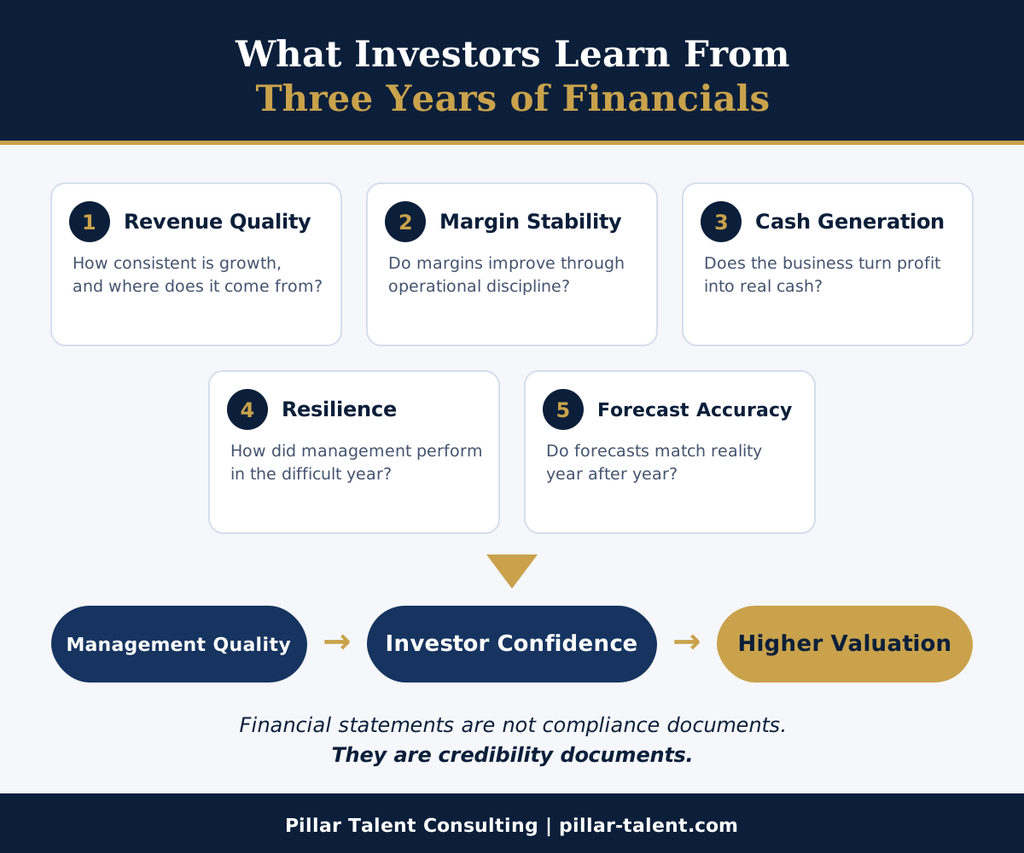
A three-year financial history allows investors to move beyond outcomes and begin evaluating behaviour. They ask questions such as:
- How does management respond to adversity?
- How consistent is revenue growth?
- How stable are margins?
- How effectively does the business generate cash?
- How resilient is the organisation during difficult periods?
A single financial statement rarely answers these questions. They emerge through patterns, and patterns are what sophisticated investors look for. This is why investors often spend less time on a company’s best year than founders expect.
Resilience Often Commands a Premium
The best year may be impressive, but the difficult year is often more revealing. A business that performs well in favourable conditions demonstrates opportunity. A business that performs well in challenging conditions demonstrates resilience. Investors value both, but resilience often commands a premium.
Why Investors Are More Selective Today
This distinction is particularly important in today’s investment environment. Capital has become more selective, interest rates have changed and economic uncertainty has increased. Investors now focus on quality rather than possibility. The era of growth at any cost has largely given way to an era of disciplined execution.
As a result, historical performance matters even more. Investors do not expect the future to mirror the past. They want evidence of management quality.
Financial Statements as Evidence of Management Quality
Management quality is one of the most difficult attributes to assess directly, so investors look for indirect indicators. Financial history provides many of them:
- A business that consistently improves margins demonstrates operational discipline.
- A company that maintains strong cash generation demonstrates financial management capability.
- An organisation that navigates difficult market conditions demonstrates adaptability.
These characteristics matter because investors are ultimately investing in decision-makers. Every number reflects a choice, every trend reflects behaviour and every outcome reflects management. Businesses with a structured Fractional CFO function are usually better placed to show this kind of decision-making discipline.
Quality of Growth Matters More Than Headline Growth
Sophisticated investors often become less interested in headline growth rates and more interested in underlying quality. Revenue growth alone tells an incomplete story. The source, profitability and sustainability of that growth all matter.
A company growing at 20% annually through disciplined execution may be considerably more attractive than a company growing at 50% through aggressive spending and weak controls. The difference lies in predictability.
Why Predictability Reduces Risk
Investors place extraordinary value on predictability. They do not expect certainty. They value predictability because it reduces risk. The future is inherently uncertain, and the more predictable a business becomes, the easier it is to assess. Reliable forecasting, supported by strong cash flow forecasting and investor reporting, is one of the clearest ways to show it.
How Historical Financials Influence Valuation
Many founders believe valuation is determined mainly by future opportunity. Opportunity is important, but opportunity without evidence is speculation. Historical performance provides the evidence. It shows:
- whether management can execute,
- whether strategies translate into results,
- whether forecasts align with reality, and
- whether growth creates value.
These considerations influence confidence, and confidence influences valuation.
The Role of Confidence in Valuation
The relationship between confidence and valuation is frequently underestimated. Two businesses may generate similar revenue and similar profits, yet one may command a significantly higher valuation. The difference is often confidence: in leadership, in systems, in reporting and in predictability.
Three years of financial history help create that confidence. They allow investors to evaluate not just what happened, but how it happened. Accurate, timely numbers come from disciplined finance operations and month-end close, which are the foundation of credible financial statements.
What Different Types of Investors Prioritise
This distinction becomes more important as businesses mature.
- Early-stage investors may focus heavily on opportunity.
- Growth-stage investors often focus equally on execution.
- Institutional investors frequently prioritise consistency.
Private equity firms, family offices and strategic acquirers typically evaluate all three. The larger the investment, the greater the emphasis on evidence.
Start Investor Readiness Years Before You Raise Capital
Investor readiness should never begin when capital is required. It should begin years earlier. The strongest fundraising processes are rarely created in the months before investment discussions. They are built through years of disciplined financial management:
- Reliable reporting
- Strong governance
- Consistent forecasting
- Clear decision-making
- Tax and regulatory compliance, supported by tax and compliance advisory
These capabilities create a financial history worth reviewing. More importantly, they create a business worth investing in. If your reporting, controls or systems are not yet investor-grade, business and finance consulting can help build the governance and control frameworks that investors expect. You can also run the Business Health Analyzer for a quick 60-second view of where your business stands.
Financial Statements Are Records of Decisions
Warren Buffett has often emphasised the importance of management quality when evaluating businesses, and the principle remains highly relevant. Financial statements are not merely records of performance. They are records of decisions, and investors are ultimately investing in the quality of those decisions.
Founders who understand this approach financial reporting differently. They do not view financial statements as compliance documents. They view them as credibility documents. Every year of disciplined execution strengthens the investment narrative, and every year of inconsistency weakens it.
Frequently Asked Questions
Why do investors usually ask for three years of financial statements?
Three years often provides enough information to identify trends, evaluate consistency, assess management quality and understand how the business performs under different conditions.
Can a business raise capital without three years of financial history?
Yes. Early-stage businesses often raise capital based on opportunity and potential. As businesses mature, however, historical performance becomes increasingly important.
What do investors look for in historical financial statements?
They look at revenue quality, profitability, cash generation, margin stability, operational discipline, growth consistency and management effectiveness.
Do investors focus more on growth or profitability?
It depends on the investment stage and strategy. Most sophisticated investors evaluate growth, profitability, cash generation and sustainability together.
How can businesses improve investor confidence before fundraising?
By strengthening financial reporting, improving forecasting accuracy, maintaining governance discipline and creating a track record of consistent execution. Our process is built around exactly this: diagnose, stabilise, systemise, optimise and scale.
Final Thought: Confidence Is Built Over Time
Investors do not ask for three years of financial statements because they want to understand your past. They ask because they want confidence in your future. The strongest businesses understand that every reporting period is an opportunity to build that confidence.
Preparing for investment, expansion or succession in the UAE? Book a consultation with Pillar Talent, or contact us to discuss your investor-readiness plan. We support businesses in Dubai, Abu Dhabi and Sharjah.
If you found this article valuable, consider sharing it with a founder, CEO, investor, board member or business owner preparing for investment, expansion or succession. For more articles like this, visit our Insights page.
At Pillar Talent, we believe that great businesses do not simply produce results. They create confidence.