
There is perhaps no statement more confusing to a business owner than this: “We made a profit, but we don’t have any cash.” At first glance, the statement appears contradictory.

Profit is supposed to represent success. It is one of the first metrics entrepreneurs learn to monitor and one of the first questions investors ask. Entire industries have been built around improving profitability. Businesses celebrate profitable years, reward profitable divisions, and evaluate leadership based on profitability.
Yet every year, profitable companies fail. Not because they lack customers. Not because they lack revenue. Not because they lack profits. They fail because they run out of cash. The distinction between profit and cash is one of the most misunderstood concepts in business, despite being one of the most important.
The Profit vs. Cash Paradox
Most founders spend years learning how to generate revenue. Far fewer spend time understanding how cash actually moves through a business. The consequences can be severe. A company can report strong profits while simultaneously struggling to pay suppliers. A business can announce record sales while delaying payroll. A growing enterprise can appear healthy on paper while quietly approaching a liquidity crisis.
This paradox exists because profit and cash tell fundamentally different stories. Profit measures performance. Cash measures survival. The two are related, but they are not the same. The confusion often begins with success itself.
How Growth Consumes Cash
When a business starts growing rapidly, founders naturally focus on generating more sales. New customers arrive. Revenue increases. Market share expands. The organisation begins hiring additional employees and investing in infrastructure.
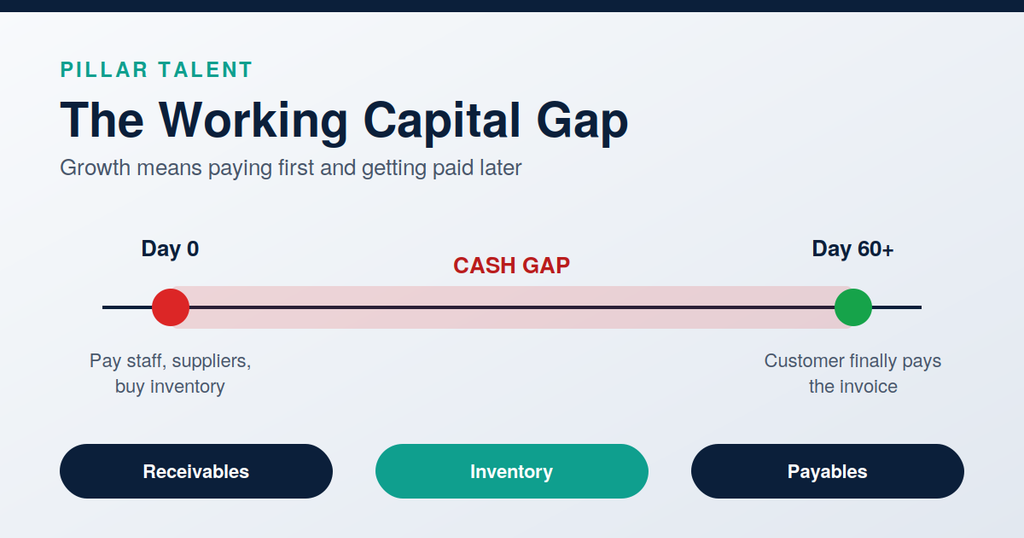
Growth feels positive because it is positive. Unfortunately, growth also consumes cash. A company that wins a large contract may need to hire staff before receiving payment. A business that secures a major customer may need to purchase inventory before generating collections.
A construction company may complete substantial work long before invoices are settled. A technology company may invest heavily in talent and product development before revenue catches up. The faster the growth, the greater the cash requirement.
This creates a surprising reality. Growth can make a business weaker before it makes the business stronger. Many founders encounter this phenomenon for the first time during periods of rapid expansion. Revenue rises. Profits improve. Yet the bank balance appears stubbornly stagnant.
The Hidden Role of Working Capital
The instinctive reaction is confusion. The explanation is usually found in working capital. Working capital rarely receives the attention it deserves because it lacks the excitement of revenue growth or profitability. Yet it is often one of the most important determinants of business resilience.
Working capital reflects the cash tied up inside daily operations:
- Money owed by customers
- Inventory sitting in warehouses
- Payments due to suppliers
The larger the gap between paying expenses and collecting revenue, the more cash the business consumes.
This explains why some of the world’s most successful businesses place enormous emphasis on working capital management. They understand that cash flow is not merely an accounting consideration. It is a strategic capability. Strong financial management and operations is what turns cash flow from an afterthought into a competitive advantage.
Cash Creates Options When the Tide Goes Out
A company that controls its cash possesses options. A company that lacks cash loses options. This principle becomes particularly relevant during periods of uncertainty. Warren Buffett once famously observed: “Only when the tide goes out do you discover who’s been swimming naked.”
Cash performs a similar function in business. When markets are strong, liquidity problems often remain hidden. Revenue growth masks inefficiencies. Easy credit compensates for poor forecasting. Investor capital fills temporary gaps. Then conditions change. Customers delay payments. Sales slow. Banks become more cautious. Investors become selective.
Suddenly the weaknesses that were previously invisible become impossible to ignore. The businesses that survive are rarely those with the highest reported profits. They are often those with the strongest cash positions.
Why Investors and Lenders Focus on Cash Flow
This distinction explains why sophisticated investors frequently pay close attention to operating cash flow rather than headline profitability. Investors understand that accounting profits can be influenced by assumptions, timing differences, depreciation methods, and various accounting treatments.
Cash is less forgiving. Cash either exists or it does not. This is one reason private equity firms, family offices, and institutional investors frequently spend substantial time analysing cash generation during due diligence processes. They are not simply evaluating profitability. They are evaluating resilience.
The same principle applies to lenders. Banks do not receive loan repayments in EBITDA. Suppliers do not accept profitability as payment. Employees cannot pay their mortgages using projected earnings. The entire economic system ultimately operates on liquidity.
Why Financial Visibility Becomes Harder as You Scale
This reality becomes increasingly important as businesses grow. Many founders initially manage cash intuitively. They know every customer. They approve every payment. They understand every transaction.
As organisations scale, this becomes impossible. Complexity increases. Cash becomes fragmented across multiple entities, projects, investments, and obligations. Visibility declines. The organisation becomes more vulnerable.
This is often the point at which financial leadership becomes essential. Many growing companies turn to fractional CFO services to gain senior-level financial guidance without the cost of a full-time executive. A sophisticated finance function does not merely report historical results. It creates forward visibility. It helps leadership understand not only what happened, but what is likely to happen next.
Forecasting: Reducing Surprises Before They Happen
This distinction is critical. Most business failures do not occur because leaders lack intelligence. They occur because leaders lose visibility. The danger is rarely what management knows. The danger is what management does not know.
A company that identifies a future cash shortage six months in advance has numerous options available. A company that identifies the same shortage six days before payroll has very few.
This is why forecasting has become one of the most valuable disciplines in modern finance. Forecasting is not about predicting the future perfectly. It is about reducing surprises. The best financial leaders understand that certainty is impossible. Visibility is not.
The Real Purpose of Financial Management
Ultimately, the purpose of financial management is not simply to record transactions. It is to preserve optionality. Cash creates options. Cash creates resilience. Cash creates flexibility. Most importantly, cash creates time. And time is often the most valuable resource available to a growing business.
The companies that endure are not always the most profitable. They are frequently the most prepared.
Strengthen Your Cash Position with Pillar Talent
Whether you need expert tax advisory to protect your cash, strategic financial consulting to plan your next stage of growth, or hands-on support from a fractional CFO, the right financial partner can help you see problems before they become crises. Learn more about how we help businesses at Pillar Talent.
Frequently Asked Questions
1. Can a profitable company really run out of cash?
Yes. Profitability and cash flow measure different things. A business can report profits while experiencing significant liquidity pressure due to working capital demands, delayed collections, or growth-related cash requirements.
2. What is the biggest cause of cash flow problems in growing businesses?
Rapid growth is often a major contributor. Growth frequently requires businesses to invest cash before revenue is collected.
3. Why do investors focus on cash flow?
Cash flow provides insight into a company’s ability to generate liquidity, fund operations, repay obligations, and withstand economic uncertainty.
4. What is working capital?
Working capital generally represents the difference between short-term assets and short-term liabilities. It reflects the cash required to support daily operations.
5. What should founders monitor besides profit?
Cash position, operating cash flow, receivables, payables, working capital trends, and forecasted liquidity requirements are often as important as profitability.
Final Thought
Revenue creates excitement.
Profit creates confidence.
Cash creates survival.
The strongest businesses understand all three.
If this article resonated with you, consider sharing it with a founder, investor, business owner, or executive who may be focused on profitability but overlooking liquidity.
At Pillar Talent, we believe that financial visibility is one of the most valuable competitive advantages a business can possess.