Most founders believe investors are evaluating potential. Most investors are evaluating risk. The distinction sounds minor, but it can decide whether a capital raise succeeds or ends in a disappointing rejection.
Every year, thousands of businesses approach investors convinced they are ready. Revenue is growing, customers are buying, the product works, the market is attractive and the founder is passionate. Yet many still fail to secure investment. Not because the opportunity lacks merit, but because investors spot risks that founders underestimate or never recognise.
Founders Look for Upside. Investors Look for Loss.
This is one of the most misunderstood parts of fundraising. Entrepreneurs spend years thinking about growth. Investors spend years thinking about loss. A founder naturally focuses on what could go right; an investor is trained to ask what could go wrong.
That difference in perspective shapes every investment decision, and it explains why businesses are so often surprised by due diligence.
What Due Diligence Is Really For
Many entrepreneurs assume due diligence exists to verify financial performance. Experienced investors know it serves a broader purpose: uncertainty reduction. The investor is not simply checking revenue, profit or growth. They are trying to answer a more important question: can this business scale without creating disproportionate risk?
The answer often has less to do with the financial statements than founders expect. Here are the red flags investors tend to notice first.
Red Flag 1: Founder Dependency
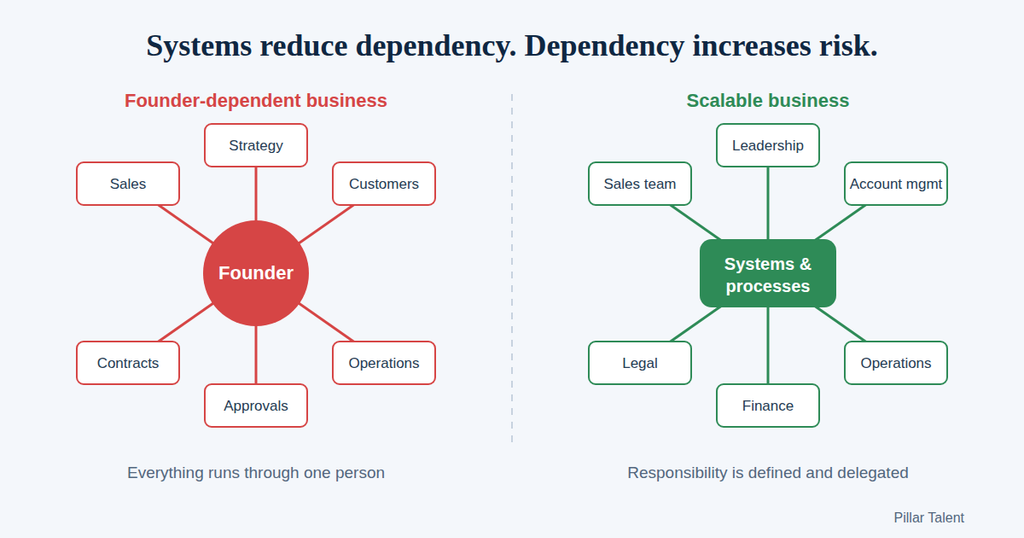
Many businesses are built around extraordinary entrepreneurs. The founder drives sales, manages key customer relationships, sets strategy, approves major spending, negotiates important contracts and resolves operational issues.
That level of involvement often fuels early success. It also creates risk. An investor quickly starts asking uncomfortable questions:
- What happens if the founder leaves?
- Who owns the customer relationships?
- Who makes the critical decisions?
- Can the business operate independently?
- Can leadership responsibilities be delegated?
The more a business depends on one person, the less attractive it usually becomes. Investors are rarely buying today’s business; they are investing in tomorrow’s scalability. Scalability requires systems, systems reduce dependency, and dependency increases risk. The strongest businesses create leverage through processes rather than personalities.

Building that leadership depth is often where a fractional CFO adds the most value, taking over financial decisions, forecasting and investor-facing reporting so the business no longer runs through the founder alone.
Red Flag 2: Financial Opacity
Many founders understand their businesses intuitively. They know which products perform best, how customers behave and where the operational bottlenecks sit. But when investors ask for detailed financial information, the picture often becomes less clear:
- Forecasts lack stated assumptions.
- Revenue classifications are inconsistent.
- Margins are difficult to explain.
- Management reports contain conflicting information.
- Historical trends are unclear.
This creates a credibility problem. Investors know every business faces challenges. What worries them is uncertainty. A business with weaknesses that management understands is usually viewed more favourably than one with strengths that management cannot explain. Visibility creates confidence; opacity creates concern.
Why Reporting Quality Reveals Leadership Quality
This is why sophisticated investors spend significant time evaluating reporting quality. They are not just reviewing numbers; they are assessing management’s ability to understand and communicate reality. Strong leaders understand their numbers. Weak reporting often signals weak visibility, and weak visibility increases risk.
Reliable numbers start with disciplined processes. Strong financial management and operations (a consistent month-end close, clean revenue classification and reports that agree with each other) give investors the confidence they are looking for.
Red Flag 3: Unclear Ownership and Governance
Ownership structures are another area where investors frequently find concerns. Many businesses evolve organically: shareholders are added, entities are created, investments are acquired and partnerships emerge. What begins as a simple structure gradually becomes complex.
Complexity itself is not necessarily a problem. Unclear complexity is. Investors become concerned when:
- ownership structures are poorly documented,
- shareholder arrangements are ambiguous, or
- governance responsibilities are undefined.
The issue is not legal; it is predictability. Investors want confidence that ownership disputes, governance conflicts or structural problems will not appear after they invest. Every unanswered question increases perceived risk, and every unresolved issue reduces confidence. Reviewing your group structure with tax advisory support well before a raise helps surface and resolve these issues early.
Investor Readiness Is About Investability, Not Just Performance
This explains why sophisticated businesses often spend years preparing before they actively seek capital. The objective is not only to improve financial performance. It is to improve investability, and the two are not always the same. A business can perform exceptionally well and still be hard to invest in. Others attract significant capital because they show extraordinary clarity, governance, visibility and scalability.
Investors are not just evaluating outcomes. They are evaluating systems. That matters even more as a business matures.
What an Investable Business Looks Like
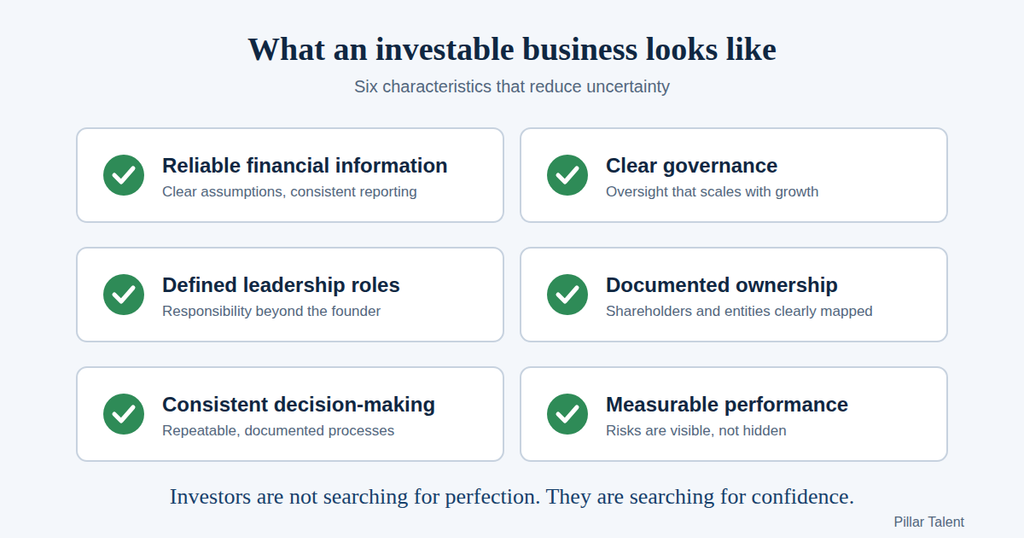
The strongest investment opportunities tend to share the same characteristics:
- Financial information is reliable.
- Governance structures are clear.
- Leadership responsibilities are defined.
- Ownership frameworks are documented.
- Decision-making processes are consistent.
- Operational performance is measurable.
- Risk is visible.

None of these guarantees success. They do something equally valuable: they reduce uncertainty. If you want an objective view of where your business stands today, our financial consulting team can help you identify gaps before an investor does.
Long-Term Value Needs Resilience, Visibility and Discipline
Charlie Munger once observed that the big money is not in the buying and selling, but in the waiting. The same principle applies to investing. Investors are not looking for short-term excitement. They want businesses capable of generating long-term value. Long-term value requires resilience, resilience requires visibility, and visibility requires discipline.
Investor Readiness Is a Business-Building Exercise
That is why investor readiness should never be treated as a fundraising exercise. It is a business-building exercise. The companies that attract investment most effectively are often the ones that would have become stronger even without the investment.
The preparation itself creates value: improved reporting, better governance, clearer accountability, stronger forecasting and enhanced visibility. These capabilities benefit customers, employees, banks, boards and investors alike. Most importantly, they benefit the founder, because investor readiness is not ultimately about raising capital. It is about building a business worthy of capital. And that is a much more valuable objective.
Frequently Asked Questions
What is the most common red flag investors identify?
Founder dependency is one of the most frequently observed risks because it creates uncertainty around scalability and continuity.
Do investors care about governance in privately owned businesses?
Yes. Governance gives investors confidence that decision-making, accountability and oversight can scale alongside growth.
Why is financial reporting so important during fundraising?
Reporting quality reflects management visibility and often influences investor confidence in leadership capabilities.
How early should businesses prepare for fundraising?
Ideally years before capital is required. Strong investor readiness is usually the result of consistent preparation rather than last-minute activity.
Can strong growth offset governance weaknesses?
Growth may attract attention, but governance weaknesses often increase perceived risk and can negatively affect investment decisions.
Final Thought: Build Confidence Before Investors Ask
Investors are not searching for perfection. They are searching for confidence. The businesses that attract capital most effectively are often those that reduce uncertainty before investors ever ask the difficult questions.
At Pillar Talent, we believe investor readiness begins long before a pitch deck is created. It begins with building a business that inspires confidence. If you are preparing for growth, investment or succession, speak with our team about where to start.
If you found this article valuable, share it with a founder, CEO, investor, board member or business owner preparing for growth, investment or succession.