
Here is a question every founder should ask after the next monthly management report lands in their inbox: after reading all thirty pages, am I actually better equipped to make a decision? For many businesses, the honest answer is no.
That is surprising given the effort involved. Finance teams spend days preparing reports, accountants reconcile transactions, analysts build dashboards, and executives receive packs full of charts, tables and commentary. Yet leadership teams still make critical decisions with incomplete visibility. The problem is not a lack of reporting. It is a lack of useful reporting.
The Core Flaw: Reports That Explain the Past
Most founder reporting packs are built to explain what happened rather than support what should happen next. The difference looks subtle, but it changes everything.
Traditional reports describe last month’s revenue, last quarter’s expenses and performance from a completed period. They tell you where the business has been. Leaders, however, are not paid to manage the past. They are paid to manage the future. A report that only documents history may satisfy compliance, accounting standards or governance obligations, but it does not necessarily improve decision-making.
Information vs. Insight: Why the Difference Matters
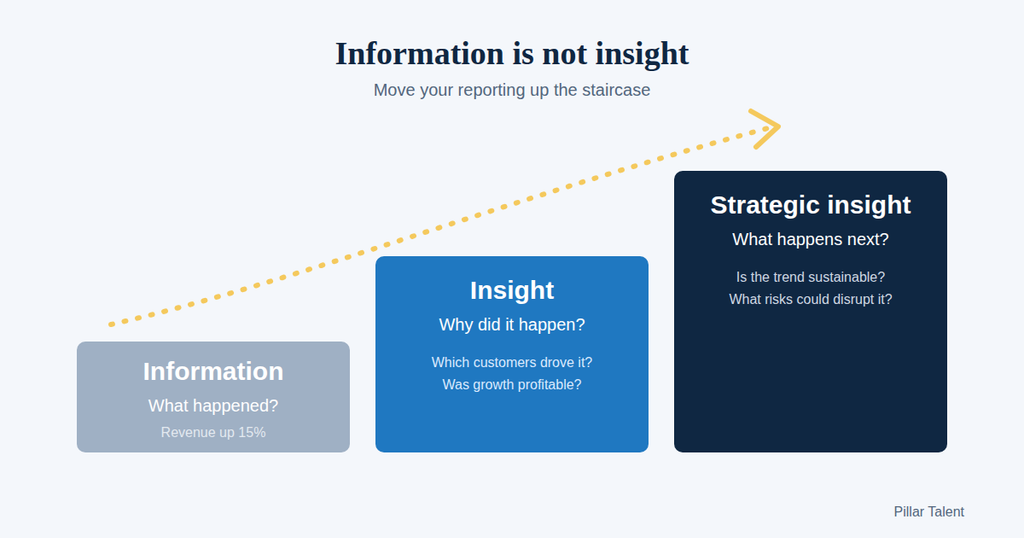
The result is a familiar situation: the leadership team receives information but not insight.
- Information tells you what happened.
- Insight explains why it happened.
- Strategic insight helps you predict what might happen next.
Most businesses invest heavily in producing information and very little in generating insight. Consider a founder who learns that revenue grew by 15%. Which customers drove that growth? Was it profitable? Is the trend sustainable? What risks could disrupt it? Without answers, the headline number is far less useful.
The same applies everywhere: rising expenses, shrinking margins, fluctuating cash balances, growing receivables. None of these observations has value on its own. Value appears only when they help leadership make a better decision.
Measurement Is Not Management
Peter Drucker is often quoted as saying, “What gets measured gets managed.” It remains true, but many businesses measure the wrong things, or measure so many things that leadership loses focus entirely.
Modern companies have more data than ever, yet decision quality has not improved at the same pace. More data does not automatically create clarity. Often it creates complexity. Picture a typical management report: revenue by product, revenue by region, expense categories, budget variances, balance sheet movements, operational statistics, customer activity and project updates. Hundreds of data points across dozens of pages, and one unanswered question: which numbers actually matter?
Operational Reporting vs. Strategic Reporting
Sophisticated leadership teams know that effective reporting is about relevance, not completeness. The goal is not to report everything. It is to highlight what needs attention.
That is the line between operational and strategic reporting. Operational reporting focuses on activity. Strategic reporting focuses on decisions. A strategic report helps leaders spot emerging opportunities, potential risks, performance deviations and future implications. It creates clarity rather than volume.
The 5 Metrics Most CEOs Actually Need
The strongest reporting frameworks are remarkably simple. Simple does not mean superficial; it means focused. A CEO rarely needs fifty key metrics. A CEO often needs five:
- Cash position
- Cash flow forecast
- Revenue quality
- Margin performance
- Working capital trends
Together, these show both current performance and future resilience, and, more importantly, they support decisions. If building a forward-looking cash view is a challenge for your team, our fractional CFO services can help you put the right metrics and forecasts in place without the cost of a full-time hire.
Why Reporting Gets Harder as You Scale
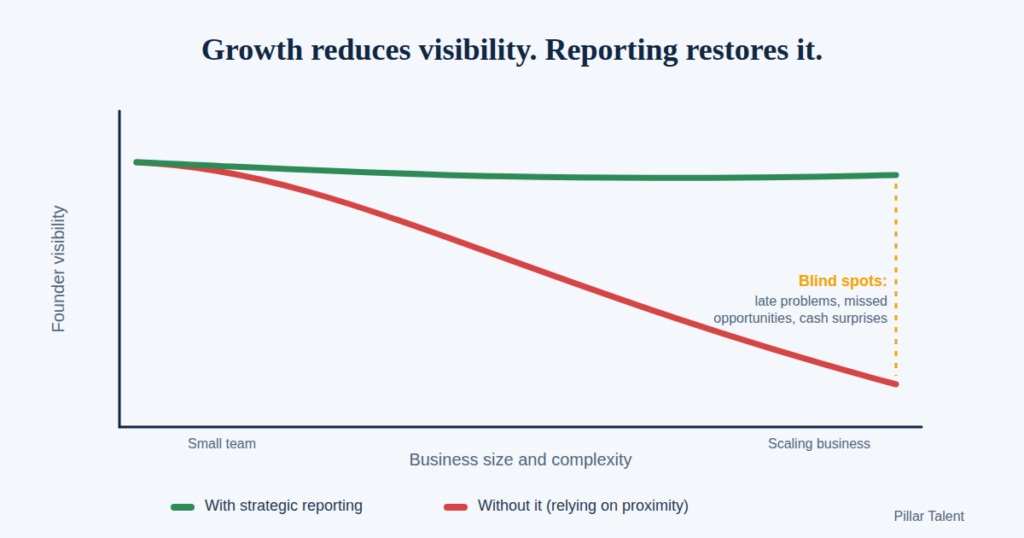
In a small company, founders compensate for weak reporting through proximity. They talk to customers directly, know every employee and review every transaction. Information flows naturally.
Growth changes that. As teams expand and complexity increases, visibility drops, and the founder becomes dependent on reporting systems to understand reality. When reporting fails, decision-making suffers. Many challenges that look operational are really reporting problems in disguise: a delayed response to an issue, a missed opportunity, an unexpected cash shortage, a deteriorating customer relationship. Each often happens because critical information was not surfaced early enough.
Strong financial management and operations (clean processes, timely close, reliable data) is the foundation that makes decision-ready reporting possible.
What Investors and Boards Already Know
Private equity firms, family offices, institutional investors and experienced boards rarely focus only on historical performance. They look for forward visibility: What risks are emerging? What assumptions are changing? Which scenarios should we plan for? Where should capital be allocated?
Those questions define strategic reporting, and the same mindset belongs inside operating businesses. A good report should not stop at “What happened?” It should answer “What requires our attention now?” and, even more importantly, “What happens next?” Whether the question is capital allocation, scenario planning or tax exposure, tax advisory and financial consulting support can add the forward-looking context that raw numbers cannot.
Reporting Should Create Clarity, Not Comfort
Jim Collins observed that great organisations confront the brutal facts while keeping faith that they will prevail. Effective reporting exists to surface those facts. Not to create comfort, activity or paperwork. To create clarity.
Ultimately, the value of a report is not measured by its page count. It is measured by the quality of the decisions that follow. A report that changes a decision has value. A report that merely fills a board pack does not.
Frequently Asked Questions
What is the biggest problem with most management reports?
Many reports focus on historical information without giving enough insight into future risks, opportunities or decisions that need to be made.
How many KPIs should a CEO realistically monitor?
It varies by business, but most CEOs benefit more from a focused set of critical indicators than from dozens of metrics.
What makes reporting strategic?
Strategic reporting supports decision-making by providing context, analysis, forward visibility and actionable insights.
Why do growing businesses struggle with reporting?
As organisations become more complex, visibility decreases and leadership relies more heavily on reporting systems to make decisions.
What should every management report include?
Clear insight into cash flow, revenue quality, profitability, working capital, performance trends, risks and future outlook.
Final Thought: Better Visibility, Better Decisions
The purpose of reporting is not to document history. It is to improve decisions. The businesses that outperform their competitors are rarely the ones with the most data; they are the ones with the greatest clarity.
At Pillar Talent, we believe better visibility leads to better decisions, and better decisions build stronger businesses. If your reporting pack is full of information but short on insight, talk to our team about turning it into a real leadership tool.
If this article resonated with you, share it with a founder, CEO, CFO, board member or business owner who may be drowning in information but searching for insight.