
Many entrepreneurs assume banks judge a business the same way founders do. They don’t, and that gap can be costly. A company can look like a clear success from the inside and still struggle to secure financing, simply because the bank is asking different questions.

Founders See Opportunity, Banks See Risk
Ask a founder how they measure success and you will hear familiar answers: revenue growth, new customers, market share, product innovation, brand recognition and profitability. These metrics matter, but they are not always the ones a lender weighs most heavily.
The reason is simple. Entrepreneurs focus on what could go right. Banks focus on what could go wrong. Neither view is mistaken, but understanding the lender’s perspective makes financing conversations far easier. Once you start thinking like a lender, you start preparing like one.
Why Revenue Alone Does Not Win a Loan
The most common misconception is that banks lend against revenue. They do not. Revenue shows commercial activity and customer demand, but on its own it tells an incomplete story. A company with AED 100 million in sales can carry far more risk than one with AED 20 million.
What lenders look for sits beneath the top line:
- How predictable is the revenue?
- How concentrated is the customer base?
- How strong is cash generation?
- How stable are margins?
- How much debt already exists?
- How dependent is the business on one founder?
- How reliable is the financial reporting?
Cash Flow Is the Metric Lenders Care About Most
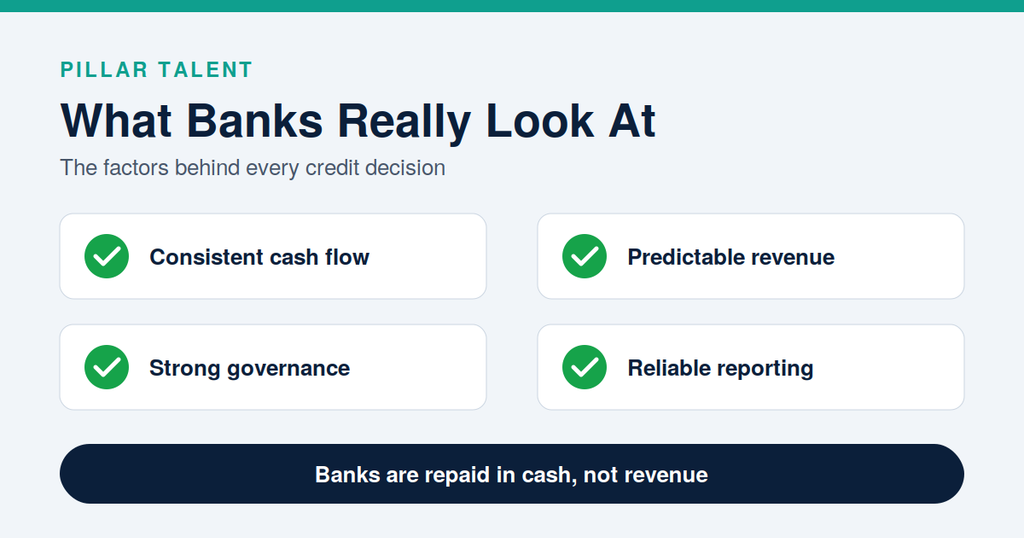
The central question for any bank is whether your business can consistently generate enough cash to repay borrowed money. Banks are repaid in cash, not in revenue or reported profit. A company with strong cash flow is viewed very differently from one that reports healthy profits but struggles with liquidity.
That is why lenders study cash flow statements, debt service coverage ratios and working capital trends so closely. They want to know whether you can still repay if conditions get harder. Good financial management and operations is what produces the steady cash performance and clean reporting they want to see.
Why Banks Plan for the Downside
Good lending decisions are built on resilience, not optimism. That is why banks often seem conservative, especially in uncertain economic periods. They stress-test a business with questions like:
- What if revenue declines?
- What if customers pay more slowly?
- What if interest rates rise?
- What if a major customer leaves?
- What if margins compress?
Founders may hear these as pessimism. Lenders see them as prudence. The goal is not to find businesses that thrive in perfect conditions, but ones that can survive imperfect ones.
When Growth and Complexity Become a Risk
Bigger does not automatically mean more attractive to a lender. Multiple entities reduce visibility, intercompany transactions complicate analysis, rapid expansion strains working capital and acquisitions increase leverage. Growth itself can become a source of risk.
So lenders begin to assess control as well as performance. Can management clearly explain the financial position of the group? Can the team produce timely, reliable reports? Can leaders spot emerging risks before they become problems? Experienced fractional CFO services can bring this level of oversight to a growing business, and clear tax advisory support helps keep multi-entity structures transparent and well organised.
Why Governance Matters More Than Founders Think
Governance rarely comes up outside boardrooms and credit committees, yet it shapes many financing decisions. Businesses with strong governance produce better information. Better information reduces uncertainty, lower uncertainty reduces perceived risk, and lower perceived risk improves financing options.
Even privately owned companies send signals through governance. Lenders often ask:
- Are responsibilities clearly defined?
- Are financial controls in place?
- Are reporting processes consistent?
- Are major decisions documented?
- Does the organisation depend on a single individual?
These answers shape confidence, and confidence shapes lending decisions.
Predictability Attracts Capital
Predictability is perhaps the most overlooked factor in financing. It makes risk easier to assess, so a company growing steadily at 10% with strong visibility may look better to a bank than one growing at 50% with significant uncertainty. Growth attracts attention. Predictability attracts capital.
When you apply for financing, you are not just handing over financial statements. You are presenting a risk profile. Every lender is asking the same thing: how confident are we that this business will keep generating enough cash to meet its obligations? The stronger your answer, the easier financing becomes.
Start Preparing Before You Apply
Sophisticated businesses improve their financial visibility long before they approach a lender, because financing conversations really begin months or even years before an application is filed. The quality of reporting, the consistency of cash generation, the strength of governance, the clarity of ownership structures and the reliability of forecasts all shape how lenders perceive risk. And perception often determines access to capital.
If you are planning a funding round, credit facility or expansion, strategic financial consulting can help you strengthen your numbers and your story before the bank sees them.
Confidence Is Built Through Visibility
Warren Buffett once observed: “Risk comes from not knowing what you’re doing.” For lenders, risk often comes from not knowing what the borrower is doing.
The businesses that secure financing most effectively remove uncertainty. They understand their numbers, they understand their risks, and they understand how lenders think. The strongest financing applications are not built on stories. They are built on confidence, and confidence is created through visibility.
Frequently Asked Questions
Do banks care more about revenue or cash flow?
Both matter, but cash flow often carries greater weight because debt is repaid using cash rather than revenue.
Why do profitable businesses sometimes struggle to obtain financing?
Profitability alone does not guarantee strong cash generation, predictable performance, or acceptable risk levels.
What financial information do banks usually review?
Financial statements, cash flow performance, debt obligations, working capital trends, ownership structures, forecasts, and management information.
Does governance matter to lenders?
Yes. Strong governance often improves financial visibility, reduces operational risk, and increases confidence in management.
How can businesses improve their financing readiness?
By strengthening reporting, improving forecasting, managing working capital effectively, maintaining financial discipline, and creating greater transparency around performance.
Final Thought
Businesses often believe they are borrowing based on performance. In reality, they are borrowing based on confidence.
Performance creates interest.
Confidence unlocks capital.
If you found this article valuable, consider sharing it with a founder, CFO, investor or business owner preparing for growth, financing or expansion.
At Pillar Talent, we help businesses improve financial visibility, strengthen decision-making, and build the confidence that lenders, investors and stakeholders look for.